MATHEMATICS01
See what slope changes.
The line turns while its intercept stays fixed. Give students a moving reference for a discussion about rate of change.
LINEAR RELATIONS
A clearer way to teach
Turn complex ideas into classroom discoveries. MendriX brings structured lessons, visual simulations, and purposeful practice together in one teaching portal.
Small ideas.
Big discoveries.
Thoughtfully connected.
Purposefully taught.
See the teaching experience
See how MendriX supports a teacher before, during, and after an explanation. You lead the lesson. The portal brings the resources together.
Grade 9 mathematics · Characteristics of Relations
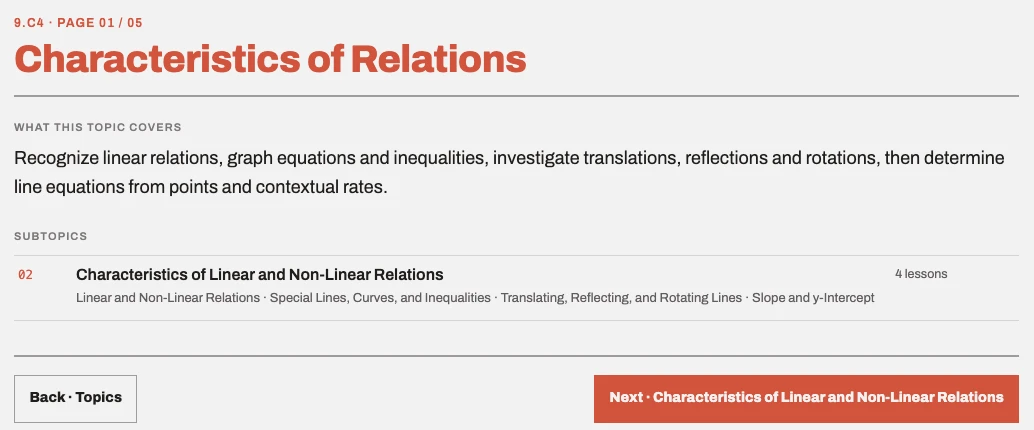
See the scopeThe objective introduces linear and non-linear relations before the lesson begins.
Follow the sequenceThe outline connects representations, special lines, transformations, and slope.
Step 1 of 4 · Plan the lesson
Spend your lesson following the idea, with the resources already connected.
See it in a guided demoCourse ideas, in motion
Following your reduced-motion preference.
Illustrative concept animations, not complete lessons or models to scale. Explore the course-specific teaching resources in a guided demo.
Better together
Between a teacher and a concept.
Between an explanation and understanding.
MendriX helps bring those moments together.
For teachers
Move from lesson objectives to visual explanations and practice, with connected resources in one place.
For students
See ideas take shape through teacher-led demonstrations, worked examples, and opportunities to practise.
For institutes
Give educators a common structure for lessons, classroom demonstrations, and assessment across supported courses.
Inside MendriX
A thoughtful flow from the first explanation to the final practice question. Resources that work together, so your teaching can too.
Visual simulations let teachers explore relationships, reveal patterns, and make abstract concepts visible to the whole class.
Objectives, explanations, worked examples, and summaries create a connected path through a topic.
Topic quizzes and printable assignments help teachers bring explanations into practice and check understanding.
QUIZZES & ASSIGNMENTSAdvanced sections and assessment options offer opportunities to explore beyond the core lesson where available.
DEEPER EXPLORATIONEnglish and French teaching material, alongside narration features, support different ways of presenting a concept.
LANGUAGE & NARRATIONResources and language coverage vary by course. Explore the fit for your classroom in a guided demo.
Built around the curriculum
See how the focus shifts across Grades 7–12, then explore the concepts within each course. Find a starting point for your next lesson or your institute’s teaching needs.
Start with patterns, models, and the world students can observe.
Link visual explanations with equations, evidence, and applications.
Move into distinct subjects and more specialized ways of thinking.
Choose a grade to see its courses at a glance. Open any course for its curriculum areas and complete topic outline.
Course focus, key topics, and room to explore.
Connect numbers, patterns, and shapes through mathematical reasoning.
View topicsExplore the areas of study and the topics within them.
Explore relationships between living things, materials, and energy.
View topicsExplore the areas of study and the topics within them.
Course focus, key topics, and room to explore.
Use relationships and data to make and explain mathematical decisions.
View topicsExplore the areas of study and the topics within them.
Investigate how parts work together in biological and physical systems.
View topicsExplore the areas of study and the topics within them.
Course focus, key topics, and room to explore.
Translate relationships between words, tables, graphs, and algebra.
View topicsExplore the areas of study and the topics within them.
Connect scientific models to ecosystems, matter, and everyday technologies.
View topicsExplore the areas of study and the topics within them.
Course focus, key topics, and room to explore.
Develop algebraic and geometric approaches to connected problems.
View topicsExplore the areas of study and the topics within them.
Use models and evidence to explain change in living and physical systems.
View topicsExplore the areas of study and the topics within them.
Course focus, key topics, and room to explore.
Study how functions behave and how their representations connect.
View topicsExplore the areas of study and the topics within them.
Apply function models to financial and periodic situations.
View topicsExplore the areas of study and the topics within them.
Connect algebra, data, and financial reasoning to practical contexts.
View topicsExplore the areas of study and the topics within them.
Make sense of the mathematics behind work and everyday spending.
View topicsExplore the areas of study and the topics within them.
Connect the diversity of life with inheritance and organism systems.
View topicsExplore the areas of study and the topics within them.
Connect particle models, chemical equations, and measurable quantities.
View topicsExplore the areas of study and the topics within them.
Describe motion and interactions through graphs and physical models.
View topicsExplore the areas of study and the topics within them.
Course focus, key topics, and room to explore.
Analyze function families and use their features to choose models.
View topicsExplore the areas of study and the topics within them.
Connect changing quantities with derivatives and spatial reasoning.
View topicsExplore the areas of study and the topics within them.
Investigate uncertainty and evaluate conclusions drawn from data.
View topicsExplore the areas of study and the topics within them.
Explain biological processes from molecules to regulating systems.
View topicsExplore the areas of study and the topics within them.
Explore how structure, energy, and reaction conditions affect chemical systems.
View topicsExplore the areas of study and the topics within them.
Use mathematical models to analyze interactions and physical phenomena.
View topicsExplore the areas of study and the topics within them.
Interpret evidence about Earth’s history and the wider universe.
View topicsExplore the areas of study and the topics within them.
These outlines describe course scope, not guaranteed lesson availability or complete syllabus coverage. Resources and language support vary by course; explore your specific needs in a demo.
Find the fit for your instituteA little more clarity
Wondering how MendriX could fit your teaching? Start here.
Let’s talk about your classroomMendriX is a teaching portal for educators and institutes. It is designed to support teacher-led lessons, with visual explanations and activities teachers can use with their students.
The portal includes mathematics and science courses across Grades 7–12, including senior biology, chemistry, physics, and mathematics. The course list above shows the current scope. We can discuss the specific lessons and resources for your courses during a demo.
A teacher selects a topic, introduces the objectives, works through explanations and visual demonstrations, then uses a summary, quiz, or printable assignment where available. Teachers remain in control of the pace and how they use the material.
The portal includes English and French interface text and authored teaching material. Some curriculum reference wording remains in English, and resource coverage varies by course. We can walk through language support for your chosen course in a demo.
This website introduces MendriX and its capabilities. Portal access and teaching resources are not provided here. Request a guided demo to discuss your teaching needs and see relevant resources.
Your inquiry is sent to the MendriX team. We use the details you provide to follow up about your institute, courses, and a suitable demonstration. Submitting a request does not create a portal account or commit you to a purchase.
Let’s bring learning to life
See what MendriX could bring to your classrooms. Let’s explore the courses, resources, and teaching possibilities that matter to you.
Tell us the grades, subjects, and teaching needs you want to explore.
See how objectives, lesson explanations, visuals, and practice connect in the portal.
Ask about the resources and language support available for your courses, and agree on any next steps.
After your inquiry is sent, the team will follow up by email to arrange the conversation.
Tell us a little about you and your institute.